Your pathway to a solid financial footing
Thank you for your decision to join the military and to serve our nation. Military life is a high calling, and while it's an exciting time, it can also be overwhelming. As you leave for basic training, you might have a one-track mind with a singular goal: Learn what you need to learn so you don’t get yelled at.
But it’s important not to focus solely on your military career. You also need to be thinking about your financial security. Here, we’ll offer tips and suggestions that are specifically designed for those who are new to the military. Think of this as your guide to financial success as a service member.
Building a strong financial foundation
There are several steps that you need to take to build a strong financial foundation, which will give you stability, sustainability and the ability to weather economic downturns. It provides financial security and peace of mind, reducing stress and allowing you to focus on the mission of protecting our nation. And since 100% of those who join the military eventually leave the military, it is the start to your eventual transition to civilian life.
Join USAA.
USAA was formed in 1922 when 25 Army officers met in San Antonio to mutually insure each other's vehicles. Obviously, we’re bit biased, but we believe USAA membership is one of the most valuable benefits of military service.
That's because USAA serves military members during their time of service and after. When their military service ends, the products USAA offers are theirs to keep and to pass down to family members. Consider joining USAA today.
Set up direct deposit.
One of the first things you'll do as you join the military is set up direct deposit. This will be at the bank where you want your military paycheck to be deposited.
Be sure to choose a bank that fits your new military career, like a checking account designed with service members in mind. You can manage your account, pay bills online and know your money is secure no matter where your military service takes you.
Create a budget.
When you join the military, it might be the first time you are earning a consistent paycheck. It's important to get the most out of what you earn, and that means creating a spending plan that gives each dollar a mission.
The mission of one dollar might be to pay for rent, another dollar might be to buy groceries and another for entertainment. To make sure you know what each dollar's mission is, it's helpful to create a budget. A budget also helps you stick with the important financial goal of spending less than you earn.
One expense many service members forget to budget for is uniforms. If you're an officer, you'll need to budget for uniform purchases. If you're enlisted, you'll have a clothing allowance but use it wisely so you can use your paycheck to fund other financial goals.
Save for emergencies.
In the military, just like in civilian life, emergencies will happen. Your car will break down, you'll need to fly back for a family member's funeral or the water heater will need replacing. That's why it's important to build an emergency fund.
We recommend having three to six months of living expenses saved in an emergency fund. When you're just getting started in military life, that can feel like a large number. So, start with a smaller goal that you can reach in a shorter timeframe. It can serve as motivation while you work towards the bigger goal.
The key is to save consistently and reach your emergency fund goal over time. If you're disciplined in your saving habits, you can get there sooner than you think. Just make sure to set these funds aside in a dedicated savings account. That way, you don’t accidentally spend emergency fund money on pizza.
Purchase an affordable vehicle.
While a fancy sports car or the newest truck might look appealing on the dealership lot, is it really what you need to get to work and back? For most people, probably not. Plus, it might not fit within your budget. And even if you can afford it, it might consume too much of your budget.
Your goal should be to keep the total cost of car ownership, which includes car payment, insurance, fuel and maintenance costs, to around 10% to 15% of your monthly income. This might mean buying a reliable used vehicle instead of a brand-new one.
One key question to ask yourself: Is this fancy new vehicle preventing you from accomplishing other financial goals? That’s why it’s important to learn how much car you can afford.
Take advantage of the Thrift Savings Plan, or TSP.
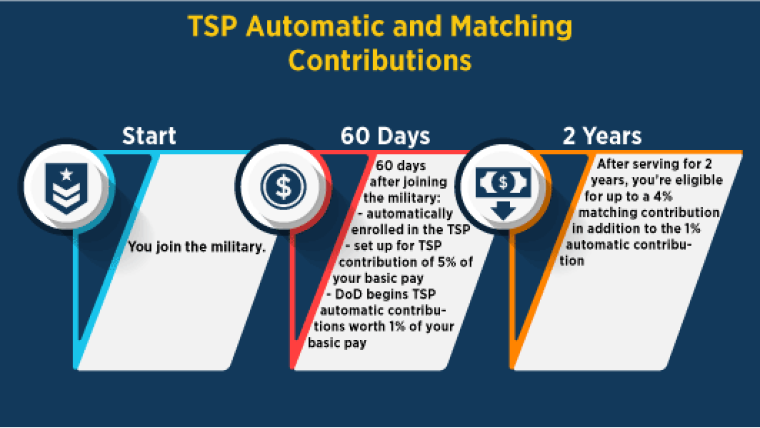
One of the best ways to achieve your retirement goals is to save early and save often. The military's version of a 401(k) is the TSP, or Thrift Savings Plan.
The graph below shows when you become eligible for the different aspects of the Blended Retirement System. We recommend contributing at least 10% of your pay toward retirement goals.